Filters
Question type

Study Flashcards

No two people are genetically identical, except for identical twins. The main source of genetic variation among humans is


A) new mutations that occurred in the preceding generation.
B) genetic drift.
C) the reshuffling of alleles in sexual reproduction.
D) environmental effects.

E) None of the above
F) B) and D)

Correct Answer

verifed

verified

Cystic fibrosis is a genetic disorder in homozygous recessives that causes death during the teenage years. If 9 in 10,000 newborn babies have the disease, what are the expected frequencies of the dominant (A1) and recessive (A2) alleles according to the Hardy-Weinberg equation?


A) f(A1) = 0.9997, f(A2) = 0.0003
B) f(A1) = 0.9800, f(A2) = 0.0200
C) f(A1) = 0.9700, f(A2) = 0.0300
D) f(A1) = 0.9604, f(A2) = 0.0392

E) B) and C)
F) B) and D)

Correct Answer

verifed

verified

Suppose 64% of a remote mountain village can taste phenylthiocarbamide (PTC) and must, therefore, have at least one copy of the dominant PTC taster allele. If this population conforms to Hardy-Weinberg (1908) equilibrium for this gene, what percentage of the population must be heterozygous for this trait?


A) 16%
B) 32%
C) 40%
D) 48%

E) A) and B)
F) C) and D)

Correct Answer

verifed

verified

HIV's genome of RNA includes the code for reverse transcriptase (RT) , an enzyme that acts early in infection to synthesise a DNA genome off of an RNA template. The HIV genome also codes for protease (PR) , an enzyme that acts later in infection by cutting long viral polyproteins into smaller, functional proteins. Both RT and PR represent potential targets for antiretroviral drugs. Drugs called nucleoside analogues (NA) act against RT, whereas drugs called protease inhibitors (PI) act against PR. Which mechanism produces variation for evolution by shuffling existing alleles?


A) rapid reproduction
B) sexual reproduction
C) mutation
D) changes in chromosome numbers

E) All of the above
F) A) and B)

Correct Answer

verifed

verified

B

A large population of laboratory animals has been allowed to breed randomly for a number of generations. After several generations, 25% of the animals display a recessive trait (aa) , the same percentage as at the beginning of the breeding program. The rest of the animals show the dominant phenotype, with heterozygotes indistinguishable from the homozygous dominants. What proportion of the population is probably heterozygous (Aa) for this trait?


A) 0.05
B) 0.25
C) 0.50
D) 0.75

E) B) and D)
F) A) and C)

Correct Answer

verifed

verified

Swine are vulnerable to infection by bird flu virus and human flu virus, which can both be present in an individual pig at the same time. When this occurs, it is possible for genes from bird flu virus and human flu virus to be combined. If the human flu virus contributes a gene for Tamiflu resistance (Tamiflu is an antiviral drug) to the new virus, and if the new virus is introduced to an environment lacking Tamiflu, then what is most likely to occur?


A) The new virus will maintain its Tamiflu-resistance gene, in case of future exposure to Tamiflu.
B) The Tamiflu-resistance gene will undergo mutations that convert it into a gene that has a useful function in this environment.
C) If the Tamiflu-resistance gene involves a cost, it will experience directional selection leading to reduction in its frequency.
D) If the Tamiflu-resistance gene confers no benefit in the current environment, and has no cost, the virus will increase in frequency.

E) B) and C)
F) C) and D)

Correct Answer

verifed

verified

If the nucleotide variability of a locus equals 0%, what is the gene variability and number of alleles at that locus?


A) gene variability = 0%; number of alleles = 0
B) gene variability = 0%; number of alleles = 1
C) gene variability = 0%; number of alleles = 2
D) gene variability > 0%; number of alleles = 2

E) None of the above
F) A) and B)

Correct Answer

verifed

verified

Which Hardy-Weinberg condition is affected by population size?


A) selection
B) genetic drift
C) gene flow
D) no mutation

E) All of the above
F) B) and C)

Correct Answer

verifed

verified

Whenever diploid populations are in Hardy-Weinberg equilibrium at a particular locus, ________.


A) the allele's frequency should not change from one generation to the next
B) natural selection, gene flow, and genetic drift are acting equally to change an allele's frequency
C) two alleles are present in equal proportions
D) individuals within the population are evolving

E) All of the above
F) None of the above

Correct Answer

verifed

verified

The inability of organisms to evolve anything that could be an advantage reflects ________.


A) the limits of choices of genes within a species
B) the inability to compromise
C) the consequences of random mutations
D) the consequences of inbreeding

E) All of the above
F) None of the above

Correct Answer

verifed

verified

A

Which statement about the beak size of finches on the island of Daphne Major during prolonged drought is true?


A) Each bird evolved a deeper, stronger beak as the drought persisted.
B) Each bird's survival was strongly influenced by the depth and strength of its beak as the drought persisted.
C) Each bird that survived the drought produced only offspring with deeper, stronger beaks than seen in the previous generation.
D) The frequency of the strong-beak alleles increased in each bird as the drought persisted.

E) C) and D)
F) A) and C)

Correct Answer

verifed

verified

Martin Wikelski and L. Michael Romero (Body size, performance and fitness in Galápagos marine iguanas, Integrative and Comparative Biology 43 [2003]:376-86) measured the snout-to-vent (anus) length of Galápagos marine iguanas and observed the percent survival of different-sized animals, all of the same age. The graph shows the log snout-vent length (SVL, a measure of overall body size) plotted against the percent survival of these different size classes for males and females. Martin Wikelski and L. Michael Romero (Body size, performance and fitness in Galápagos marine iguanas, Integrative and Comparative Biology 43 [2003]:376-86)  measured the snout-to-vent (anus)  length of Galápagos marine iguanas and observed the percent survival of different-sized animals, all of the same age. The graph shows the log snout-vent length (SVL, a measure of overall body size)  plotted against the percent survival of these different size classes for males and females.   -Currently the only predators of Galápagos marine iguanas are Galápagos hawks. Iguana body size is not correlated with risk of hawk predation, although small iguanas can sprint faster than large iguanas. If predators (for example, cats)  that preferably catch and eat slower iguanas are introduced to the island, iguana body size is likely to ________ in the absence of other factors; the iguanas would then be under ________ selection. A)  increase; directional B)  increase; disruptive C)  decrease; directional D)  decrease; disruptive -Currently the only predators of Galápagos marine iguanas are Galápagos hawks. Iguana body size is not correlated with risk of hawk predation, although small iguanas can sprint faster than large iguanas. If predators (for example, cats) that preferably catch and eat slower iguanas are introduced to the island, iguana body size is likely to ________ in the absence of other factors; the iguanas would then be under ________ selection.


A) increase; directional
B) increase; disruptive
C) decrease; directional
D) decrease; disruptive

E) None of the above
F) B) and D)

Correct Answer

verifed

verified

In the formula for determining a population's genotype frequencies, the "2" in the term 2pq is necessary because ________.


A) the population is diploid
B) heterozygotes can come about in two ways
C) the population is doubling in number
D) heterozygotes have two alleles

E) None of the above
F) A) and C)

Correct Answer

verifed

verified

B

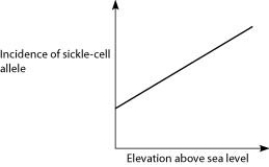
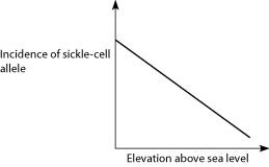
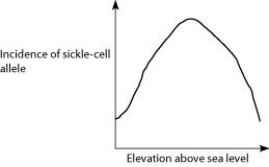
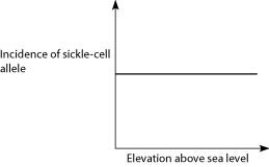
Anopheles mosquitoes, which carry the malaria parasite, cannot live above elevations of 1,800 metres. In addition, oxygen availability decreases with higher altitude. Consider a hypothetical human population that is adapted to life on the slopes of Mt. Kilimanjaro in Tanzania, a country in equatorial Africa. Mt. Kilimanjaro's base is about 800 metres above sea level and its peak is 5,895 metres above sea level. If the incidence of the sickle-cell allele in the population is plotted against altitude (metres above sea level) , which of the following distributions is most likely, assuming little migration of people up or down the mountain?


A)
Anopheles mosquitoes, which carry the malaria parasite, cannot live above elevations of 1,800 metres. In addition, oxygen availability decreases with higher altitude. Consider a hypothetical human population that is adapted to life on the slopes of Mt. Kilimanjaro in Tanzania, a country in equatorial Africa. Mt. Kilimanjaro's base is about 800 metres above sea level and its peak is 5,895 metres above sea level. If the incidence of the sickle-cell allele in the population is plotted against altitude (metres above sea level) , which of the following distributions is most likely, assuming little migration of people up or down the mountain? A)    B)    C)    D)
B)
Anopheles mosquitoes, which carry the malaria parasite, cannot live above elevations of 1,800 metres. In addition, oxygen availability decreases with higher altitude. Consider a hypothetical human population that is adapted to life on the slopes of Mt. Kilimanjaro in Tanzania, a country in equatorial Africa. Mt. Kilimanjaro's base is about 800 metres above sea level and its peak is 5,895 metres above sea level. If the incidence of the sickle-cell allele in the population is plotted against altitude (metres above sea level) , which of the following distributions is most likely, assuming little migration of people up or down the mountain? A)    B)    C)    D)
C)
Anopheles mosquitoes, which carry the malaria parasite, cannot live above elevations of 1,800 metres. In addition, oxygen availability decreases with higher altitude. Consider a hypothetical human population that is adapted to life on the slopes of Mt. Kilimanjaro in Tanzania, a country in equatorial Africa. Mt. Kilimanjaro's base is about 800 metres above sea level and its peak is 5,895 metres above sea level. If the incidence of the sickle-cell allele in the population is plotted against altitude (metres above sea level) , which of the following distributions is most likely, assuming little migration of people up or down the mountain? A)    B)    C)    D)
D)
Anopheles mosquitoes, which carry the malaria parasite, cannot live above elevations of 1,800 metres. In addition, oxygen availability decreases with higher altitude. Consider a hypothetical human population that is adapted to life on the slopes of Mt. Kilimanjaro in Tanzania, a country in equatorial Africa. Mt. Kilimanjaro's base is about 800 metres above sea level and its peak is 5,895 metres above sea level. If the incidence of the sickle-cell allele in the population is plotted against altitude (metres above sea level) , which of the following distributions is most likely, assuming little migration of people up or down the mountain? A)    B)    C)    D)

E) B) and C)
F) A) and B)

Correct Answer

verifed

verified

Comparisons of Neanderthal DNA revealed that there are more similarities to non-African DNA than reference sequences from West Africans. Additionally, scientists found that Neanderthal DNA is as closely related to East Asians as to Europeans. This indicates that interbreeding occurred before human migration further east. What process of population genetics generated these results?


A) adaptive evolution
B) gene flow
C) gene drift
D) nonrandom mating

E) A) and B)
F) A) and C)

Correct Answer

verifed

verified

In a Hardy-Weinberg population with two alleles, A and a, that are in equilibrium, the frequency of the allele a is 0.3. What is the frequency of individuals that are homozygous for this allele?


A) 0.09
B) 0.49
C) 0.9
D) 9.0

E) B) and C)
F) A) and D)

Correct Answer

verifed

verified

Researchers studying a small milkweed population note that some plants produce a toxin and other plants do not. They identify the gene responsible for toxin production. The dominant allele (T) codes for an enzyme that makes the toxin, and the recessive allele (t) codes for a nonfunctional enzyme that cannot produce the toxin. Heterozygotes produce an intermediate amount of toxin. The genotypes of all individuals in the population are determined (see chart) and used to determine the actual allele frequencies in the population. Researchers studying a small milkweed population note that some plants produce a toxin and other plants do not. They identify the gene responsible for toxin production. The dominant allele (T)  codes for an enzyme that makes the toxin, and the recessive allele (t)  codes for a nonfunctional enzyme that cannot produce the toxin. Heterozygotes produce an intermediate amount of toxin. The genotypes of all individuals in the population are determined (see chart)  and used to determine the actual allele frequencies in the population.   Is this population in Hardy-Weinberg equilibrium? A)  Yes. B)  No; there are more heterozygotes than expected. C)  No; there are more homozygotes than expected. D)  More information is needed to answer this question. Is this population in Hardy-Weinberg equilibrium?


A) Yes.
B) No; there are more heterozygotes than expected.
C) No; there are more homozygotes than expected.
D) More information is needed to answer this question.

E) A) and B)
F) A) and C)

Correct Answer

verifed

verified

The following experiment is used for the corresponding question. A researcher discovered a species of moth that lays its eggs on oak trees. Eggs are laid at two distinct times of the year: early in spring when the oak trees are flowering and in midsummer when flowering is past. Caterpillars from eggs that hatch in spring feed on oak flowers and look like oak flowers. But caterpillars that hatch in summer feed on oak leaves and look like oak twigs. How does the same population of moths produce such different-looking caterpillars on the same trees? To answer this question, the biologist caught many female moths from the same population and collected their eggs. He put at least one egg from each female into eight identical cups. The eggs hatched, and at least two larvae from each female were maintained in one of the four temperature and light conditions listed below. The following experiment is used for the corresponding question. A researcher discovered a species of moth that lays its eggs on oak trees. Eggs are laid at two distinct times of the year: early in spring when the oak trees are flowering and in midsummer when flowering is past. Caterpillars from eggs that hatch in spring feed on oak flowers and look like oak flowers. But caterpillars that hatch in summer feed on oak leaves and look like oak twigs. How does the same population of moths produce such different-looking caterpillars on the same trees? To answer this question, the biologist caught many female moths from the same population and collected their eggs. He put at least one egg from each female into eight identical cups. The eggs hatched, and at least two larvae from each female were maintained in one of the four temperature and light conditions listed below.   In each of the four environments, one of the caterpillars was fed oak flowers, the other oak leaves. Thus, there were a total of eight treatment groups (4 environments × 2 diets) . Which of the following is a testable hypothesis that would explain the differences in caterpillar appearance observed in this population? A)  The longer day lengths of summer trigger the development of twig-like caterpillars. B)  Winter causes ugly caterpillars and trees. C)  Differences in air pressure, due to differences in elevation, trigger the development of different types of caterpillars. D)  Differences in diet trigger the development of different types of caterpillars. In each of the four environments, one of the caterpillars was fed oak flowers, the other oak leaves. Thus, there were a total of eight treatment groups (4 environments × 2 diets) . Which of the following is a testable hypothesis that would explain the differences in caterpillar appearance observed in this population?


A) The longer day lengths of summer trigger the development of twig-like caterpillars.
B) Winter causes ugly caterpillars and trees.
C) Differences in air pressure, due to differences in elevation, trigger the development of different types of caterpillars.
D) Differences in diet trigger the development of different types of caterpillars.

E) None of the above
F) A) and B)

Correct Answer

verifed

verified

In the formula for determining a population's genotype frequencies, the "pq" in the term 2pq is necessary because ________.


A) the population is diploid
B) heterozygotes can come about in two ways
C) the population is doubling in number
D) heterozygotes have two alleles

E) B) and D)
F) A) and C)

Correct Answer

verifed

verified

The Dunkers are a religious group that moved from Germany to Pennsylvania in the mid-1700s. They do not marry with members outside their own immediate community. Today, the Dunkers are genetically unique and differ in gene frequencies, at many loci, from all other populations including those in their original homeland. Which of the following mechanisms likely explains the genetic uniqueness of this population?


A) population bottleneck and Hardy-Weinberg equilibrium
B) heterozygote advantage and stabilising selection
C) mutation and natural selection
D) founder effect and genetic drift

E) A) and D)
F) All of the above

Correct Answer

verifed

verified

Showing 1 - 20 of 64

Related Exams

Show Answer